On this page
- Two ways to ask the ground the same question
- Side by side
- Why SPT is still the default in Central Florida
- Where CPT beats the boring
- When a project needs both
- Cost and time, without the sales pitch
- What the plans examiner is actually looking for
- Tell us the site and we'll tell you the test
- Frequently asked questions
For most Florida buildings the answer is SPT borings: a typical house needs 2–4 borings to 20–30 feet, a residential geotechnical report runs $1,500–$3,500, and the N-values and soil samples that come out of the hole are what Florida Building Code foundation design is written around. CPT earns its place on soft or organic ground, on large footprints where a continuous profile is worth paying for, and in the overburden of a sinkhole investigation — and it stops dead the moment it meets limestone. Here's how we decide which rig goes on the trailer, and when a site gets both.
Two ways to ask the ground the same question
Both tests push something into the soil and measure how hard the soil pushes back. Almost everything else about them is different.
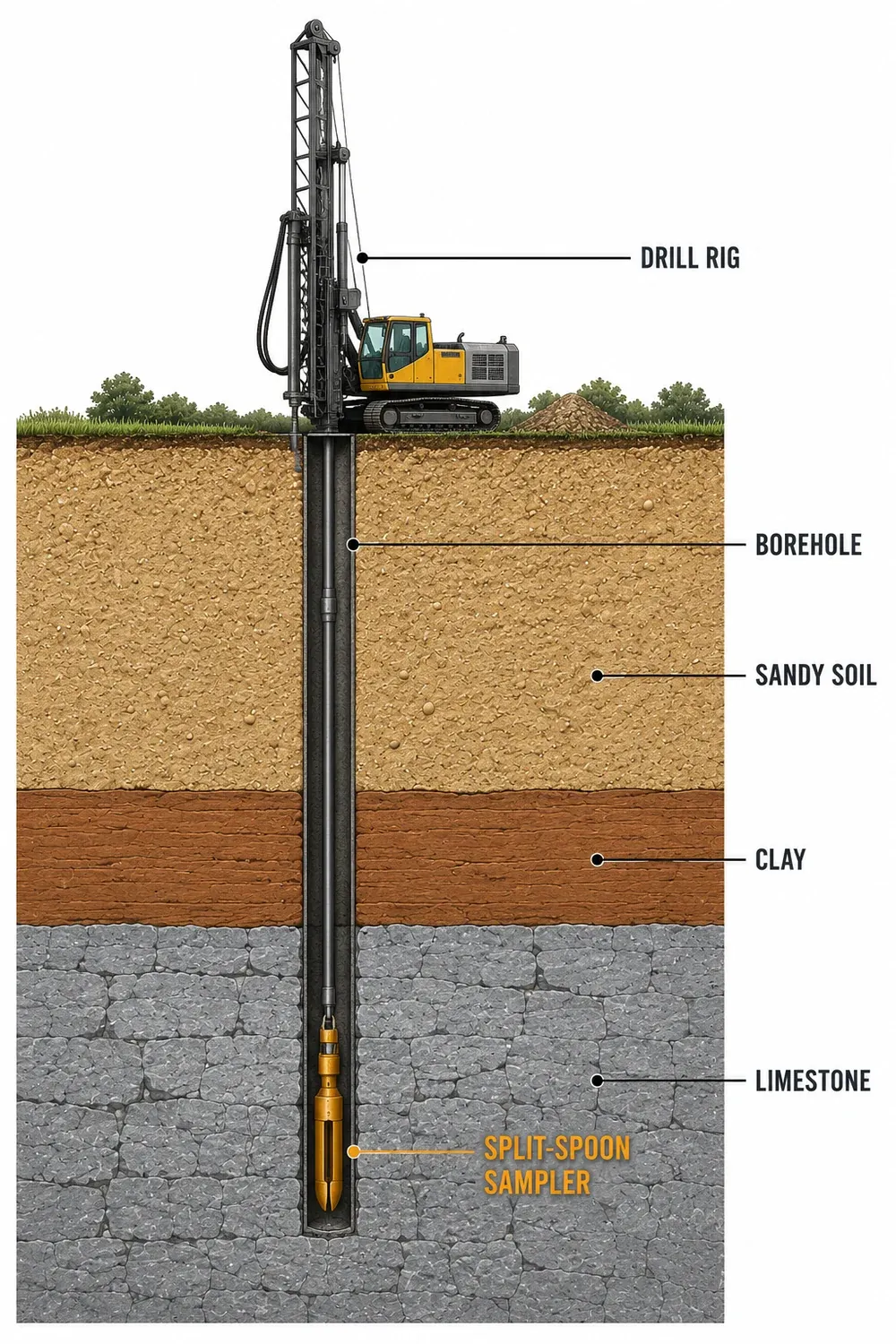
SPT: the Standard Penetration Test
A drill rig advances a borehole — hollow-stem auger through Florida's saturated sands, rotary wash when we need to go deep or get through rock — and at set depths a 2-inch split-spoon sampler is driven 18 inches by a 140-pound hammer falling 30 inches. The crew counts hammer blows for each 6-inch increment; the blows for the last 12 inches are the N-value. That's ASTM D1586, and it's the same test on every log in the state. Samples typically come up every 2.5 feet in the upper part of the hole and every 5 feet below that, and every one of them goes in a jar, gets labeled, and rides back to our lab in Ocala. These are the SPT borings and CPT soundings our own crews run across Florida, so the same people who watched the spoon come up are the ones who hand the sample to the lab.
An SPT boring gives you two things: a number that correlates to soil strength and density, and a physical sample you can look at, classify, and test. On an automatic-hammer rig the energy is consistent from blow to blow, which is why the N-values on our logs go straight into bearing-capacity and pile-capacity correlations instead of being corrected for a tired driller.
CPT: the Cone Penetration Test
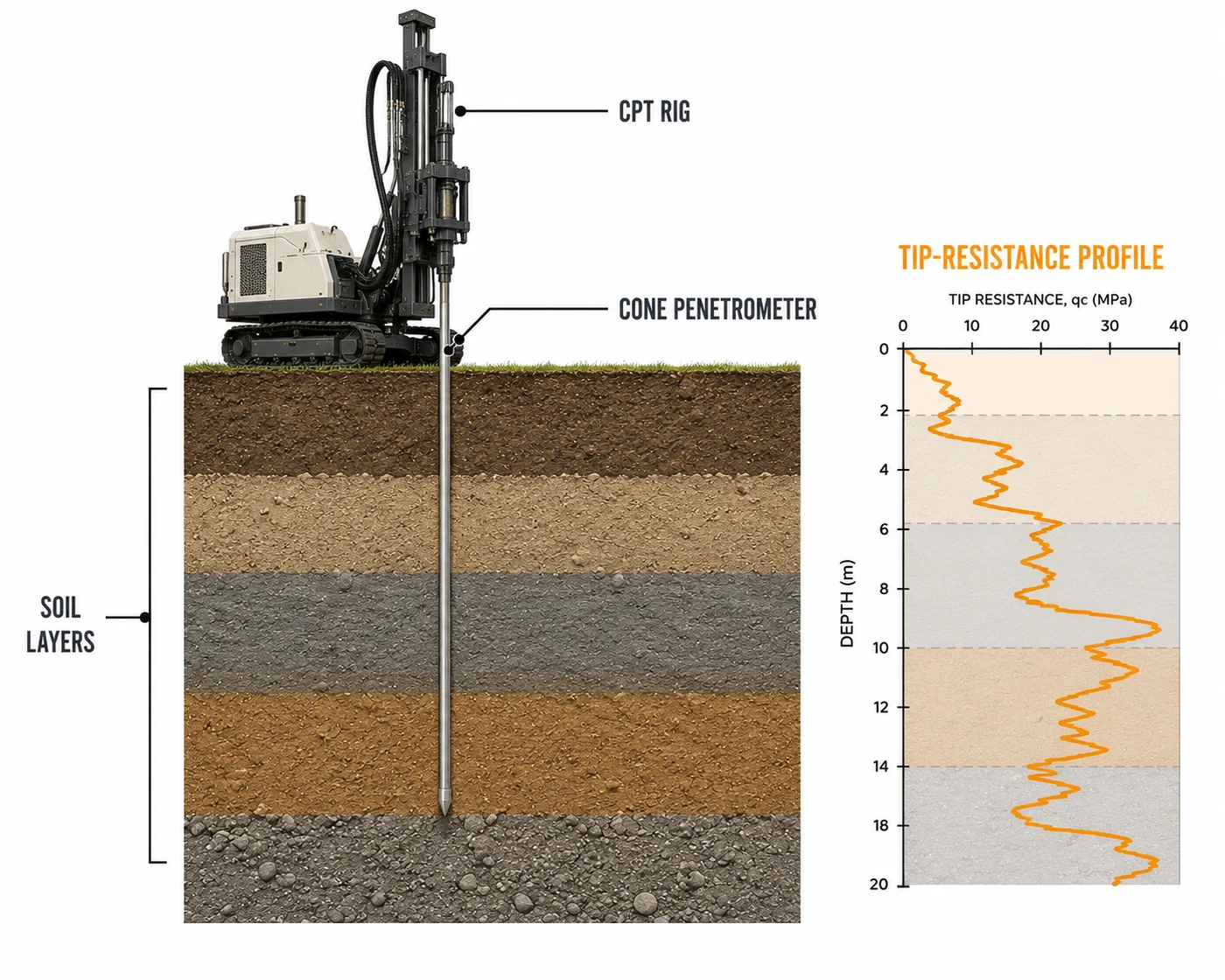
No drilling, no hammer, no samples. A rig with roughly 20 tons of reaction weight pushes an instrumented steel cone — 60-degree tip, about an inch and a half across — into the ground at a steady 2 centimeters per second. Sensors behind the tip record tip resistance and sleeve friction continuously, about every inch of depth. A piezocone adds pore-water pressure, which is what separates a clay from a sand when both feel the same to the cone. That's ASTM D5778. Soil type is inferred from the ratios using published correlation charts. It is not observed in a jar.
The result is a continuous profile: a line, not a series of dots. A 6-inch layer of soft organic silt at 23 feet shows up as a sharp dip in tip resistance. In an SPT boring sampled at 5-foot intervals, that same layer can sit between two samples and never appear on the log at all.
Side by side
| SPT boring | CPT sounding | |
|---|---|---|
| What you get | N-values at sample depths plus physical soil samples | Continuous tip resistance, sleeve friction, and pore pressure |
| Vertical resolution | Every 2.5–5 ft | About every inch |
| Samples for the lab | Yes — classification, organic content, Atterberg limits, Proctor, and consolidation on tube samples | None. Soil type is inferred, not observed |
| Limestone, hardpan, shell | Rotary wash drills through it; lost circulation flags voids; rock coring adds RQD | Refusal. The cone stops at the rock surface, or on a shell bed or cemented sand above it |
| Soft clay, muck, peat | N-values of zero and poor sample recovery; needs tube samples | Excellent — resolves thin soft layers and their pore-pressure response |
| Groundwater | Measured in the open borehole | Estimated from pore-pressure dissipation tests |
| What it feeds | FBC and FDOT foundation-design correlations, the lab program, the stamped report | Layer mapping, settlement and liquefaction screening, deciding where to bore |
| Production (typical industry figures, not a quote) | Roughly 100–200 ft of drilling per rig-day, more in clean sand | Roughly 300–500 ft of sounding per rig-day wherever the cone can push |
| Footprint on your site | Cuttings and drilling fluid; needs rig access | Almost no spoils; a sealed inch-and-a-half hole |
Why SPT is still the default in Central Florida
Three reasons, and none of them is habit.
The design methods are built on N-values. Chapter 18 of the Florida Building Code lets a building official require a geotechnical investigation, and once one is required the structural engineer needs allowable bearing pressure, settlement estimates, and, for anything on piles, capacities. The correlations that go into a Florida foundation report, and the FDOT Soils and Foundations Handbook procedures for driven-pile and drilled-shaft design, are written around SPT N-values. You can convert cone resistance to an equivalent N, but that conversion is one more assumption sitting between the ground and the seal. Reviewers know the difference, and so does the engineer doing the foundation engineering for Florida soils off the back of the logs.
The lab needs a sample. Organic content, plasticity, grain size, Proctor compaction, consolidation — every one of those is a test on soil in a jar or a tube. The cone can tell you a layer is soft. It cannot tell you whether it's soft because it's a clay that will consolidate for a decade or a peat that should be dug out before the pad goes down. Our samples go straight to our FDOT- and CMEC-accredited soil testing laboratory in Ocala, and the lab data is what turns a strength profile into a recommendation someone can build to.
Florida has rock in the way. Across Marion, Citrus, Hernando, and Sumter counties the Ocala Limestone is often 10 to 40 feet down, sometimes closer, and its surface is pinnacled — high points and troughs a few feet apart. A cone that refuses at 18 feet has told you there's something hard at 18 feet. It hasn't told you whether that's the top of continuous rock, a single pinnacle with 15 feet of sand beside it, or a floating boulder. An SPT rig switched to rotary wash drills through, and it gives you the one signal that matters most in karst country: drilling fluid disappearing into the ground. Lost circulation is a void, and there is no cone equivalent. When the question is the rock itself, we core it and report RQD. We went county by county on what's under the karst belt in Sinkhole Alley explained for Citrus, Hernando, Sumter, and Marion counties.
Where CPT beats the boring
Now the honest flip side. Plenty of firms around the state treat the cone as an afterthought, and on the right site that costs the client real money.
- Thin weak layers. The 6-inch seam of soft silt or loose sand between two SPT samples is exactly what settles a slab unevenly. The cone can't miss it. A boring program on 5-foot intervals can.
- Muck, peat, and soft clay. The St. Johns floodplain in Putnam County, lake margins in Lake County, coastal Citrus. When the spoon comes up empty and the log says N=0, you've learned the layer is there and almost nothing else. The cone actually characterizes it: thickness, stiffness, how it responds to pore pressure.
- Big footprints. A warehouse slab in Sumter County or around The Villages covers acres. Borings on a grid tight enough to catch a muck pocket get expensive fast. Cone soundings between the borings map the layers at a fraction of the per-hole cost, and the borings calibrate the cone.
- Raveling above a cavity. In a sinkhole investigation, the soil above a void loses density as it washes downward into the rock. That reads as a zone of very low tip resistance, and the cone can outline it faster than a boring grid, right up to the rock surface, where the boring has to take over.
- Repeatability. No driller judgment, no hammer, no sample disturbance. Two cone rigs on the same spot produce the same line. That matters on settlement-sensitive structures and on any job where the data will be argued over later.
When a project needs both
The either/or framing is wrong more often than it's right. The combination that works in this part of the state is CPT for coverage and SPT for confirmation and the lab. In practice:
| Project | What we usually recommend | Why |
|---|---|---|
| Single-family home, native sand, no red flags | SPT only: 2–4 borings to 20–30 ft | Code correlations, lab, stamp. CPT adds a mobilization for data you wouldn't use. |
| Home or addition on suspected fill, organics, or a wet lot | SPT, plus CPT if the borings hit soft material | The cone defines the soft layer's thickness and extent; the boring provides the sample to test. |
| Commercial or warehouse pad (Sumter, Marion, Lake) | SPT at columns and perimeter; CPT soundings across the slab | Continuous coverage of a big footprint without a boring every 50 feet. |
| Sinkhole investigation (Citrus, Hernando, western Marion) | GPR screen, then SPT at the anomalies to 10 ft into rock; CPT in the overburden where it helps | Only drilling sees lost circulation and cores the rock. The cone cannot confirm karst. |
| Deep muck or soft clay (Putnam, coastal lowlands) | CPT-led, with SPT and tube samples for consolidation testing | The cone maps the soft profile; the lab supplies the settlement parameters. |
| FDOT bridges, walls, and structures | SPT and rock coring per the FDOT handbook; CPT as a supplement | FDOT design procedures are SPT-based; coring feeds the rock-socket design. |
Cost and time, without the sales pitch
The numbers we'll stand behind are the ones already on this site. A residential geotechnical report — borings, lab, engineering, seal — generally runs $1,500 to $3,500; commercial site explorations run $5,000 to $20,000 and up depending on footprint, loads, and boring depth. Drilling for a residential or small commercial site is usually one day, mobilization to most Central Florida sites is one to two business days, our lab turns index tests in 5–7 days, and stamped reports go out in three to four weeks, faster when the schedule demands it. What moves the number is in our guide to what a geotechnical report costs in Florida.
Where CPT fits into that, labeled as industry-typical rather than a quote: a cone rig pushes three to five times the footage an SPT crew drills in a day, so per foot the two usually land in the same range and the cone is often cheaper. The real saving is the lab you don't run on a sounding. That's also the catch. If the project needs samples, needs rock, or needs a report a Florida building department will accept without argument, the cone is an addition to the boring program, not a replacement for it. On a site that needs both, expect a second mobilization unless the two rigs can be scheduled together. On a site that only needs SPT, adding CPT is money spent on a line you'll never use.
The one place we'll push back on a cheaper scope is karst country. A CPT-only investigation in Citrus or Hernando County that refuses at 20 feet and calls it rock has not answered the sinkhole question. It has stopped asking. The building department may not know that. Your foundation will.
What the plans examiner is actually looking for
Florida doesn't automatically require a soil test for a house. Most counties will permit on the code's presumptive values — 2,000 psf for the sands that cover most of the state — but any building official can require an investigation the moment the site looks questionable, and commercial work should plan on one. We covered which counties ask for what in our county-by-county guide to soil testing for a building permit in Florida. When a report is required, what the reviewer expects to see is boring logs with N-values, groundwater, lab results, and a Florida P.E.'s seal — the deliverable behind our geotechnical engineering services across Florida. CPT data is welcome in the appendix. On its own, in our experience, it starts a conversation with the reviewer rather than ending one.
Tell us the site and we'll tell you the test
Send us the parcel, the structure, and anything you already know about the ground. An engineer, not a sales rep, will tell you whether the job needs borings, a cone, or both — and why — before anyone quotes it. Our own rigs, our own accredited lab, and a Florida P.E. on every report, from Ocala to all 67 counties. Start with the free quote form or call (352) 619-9292. The full menu of geotechnical drilling services in Florida — SPT, CPT, rock coring, and direct push — is one page over.