Home  /  Geotechnical Engineering in Ocala, FL

Geotechnical Engineering in Ocala, FL

Geotechnical engineering, drilling, soil testing, and CMT in Ocala & Marion County — from our headquarters and accredited lab on SW 33rd Ave. (352) 619-9292.

  • FDOT Accredited Lab
  • CMEC Accredited
  • In-House Laboratory
  • All 67 FL Counties
Geotechnical Engineering in Ocala, FL

HEADQUARTERED IN OCALA — 302 SW 33RD AVE

Every other page on this site tells you how fast we can get to your county. This one is simpler: we’re already here. FGS is headquartered in Ocala — the drill rigs, the field crews, and the FDOT- and CMEC-accredited laboratory all operate from SW 33rd Ave. If your project is in Marion County, the lab running your samples is a few minutes from your site, and so is the engineer stamping your report.

The Rock Under This County Is Named After the City

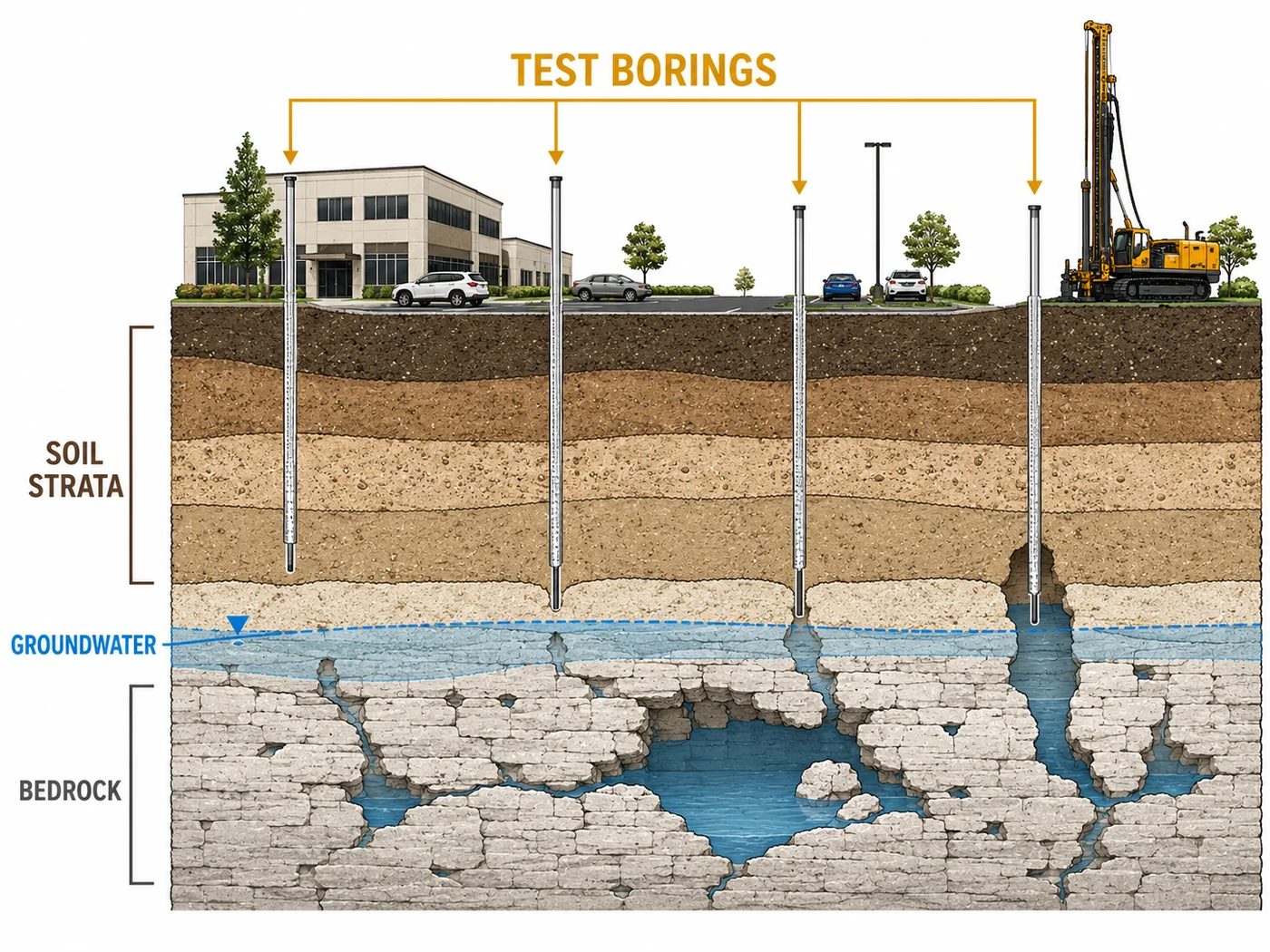
Geologists call the limestone that underlies most of the Florida peninsula the Ocala Limestone — named here, because Marion County is where it was first described and where it sits closest to the surface. The county rides the crest of the Ocala Platform, a structural high where the Eocene limestone that lies hundreds of feet deep elsewhere in Florida comes up to within a few feet of grade under a thin blanket of sand.

That geology is why Marion County looks the way it does. The calcium-rich soils weathered from that limestone grow the grass that made northwest Marion the horse capital of the world. The same limestone feeds Silver Springs and Rainbow Springs, two of the largest artesian spring systems in the country. And the same limestone — soluble, pinnacled, and full of dissolution features — is why parts of the county sit inside Florida’s most active sinkhole belt.

For foundations, the practical picture varies sharply across the county:

Northwest Marion and the horse country

limestone shallow, sometimes within excavation depth. Pinnacled rock surfaces mean bearing conditions can change across a single building pad; a footing on rock at one corner and on sand-filled slot between pinnacles at the other settles differentially.

The urban core and the SR 200 corridor

sand over limestone at moderate depth, generally favorable, but with karst features scattered enough that commercial work warrants borings deep enough to see the rock, not just the sand above it.

West toward Dunnellon and the Rainbow River

the most karst-active part of the county. Solution features, raveling zones, and soft soil pockets show up regularly in borings; this is where sinkhole investigations concentrate.

East into the Ocala National Forest

the Big Scrub: deep, clean, excellently drained sands. Easy digging and good percolation, but loose in the upper profile, so density and compaction control matter more than rock.

South through Belleview, Silver Springs Shores, and Marion Oaks — transitional ground, plus large platted subdivisions where decades of scattered fill placement mean the soil under any given lot may not be what the parcel next door has.

What We Do From Here

Ocala is where our full scope is cheapest and fastest to deliver, because nothing has to travel. SPT and auger borings get scheduled without a mobilization premium. Samples go straight to our accredited soil lab the same day they come out of the ground. Construction materials testing — field density, concrete sampling, Florida Building Code Chapter 17 special inspections — can be dispatched same-day for urgent calls because the technicians start their morning a few miles from most Marion County job sites. The engineering deliverable is the same statewide: a geotechnical report with foundation recommendations, signed and sealed by a Florida P.E.

Marion County work also regularly pulls in foundation engineering for structures that can’t sit on conventional footings, GPR surveys to screen building pads and suspect depressions before anyone drills, and Phase I environmental site assessments for commercial acquisitions — Ocala’s older commercial corridors have long industrial histories, and lenders increasingly want the ESA before closing.

Ocala Is Building — Fast

Marion County has become one of the fastest-growing metros in the state, and the construction follows three distinct patterns, each with its own geotechnical demands.

The I-75 logistics corridor. Ocala’s position at the crossroads of I-75 and the routes to both coasts has drawn national distribution tenants and million-square-foot warehouse boxes. Tilt-up construction on big footprints is unforgiving of differential settlement — slab tolerances are tight, racking systems are tall, and the earthwork program (stripping, compaction, proof-rolling, density testing) is where those projects are won or lost. That’s boring programs sized to the footprint, deep enough to see the limestone, and CMT crews on site through mass grading.

The equestrian economy. The World Equestrian Center and the farm belt around it drive a steady run of covered arenas, barns, and support buildings in the northwest county — long-span structures on shallow-limestone ground, plus footing and drainage design where the performance surface is the entire point of the facility.

Residential growth. The SR 200 corridor, On Top of the World’s continued expansion, and new subdivisions south and west of the city mean mass-graded residential land, often on ground that needed judgment first: karst screening on the west side, organic and fill assessment in the older platted communities, compaction control everywhere.
Who Hires Us in Marion County

General contractors who need borings and a stamped report to start design, and density testing once dirt starts moving. Civil and structural engineers who want a geotech who answers the phone and defends the numbers. Developers doing due diligence on land where the parcel map says nothing about what’s under the sand. Homeowners with stair-step cracks who need to know — with a professional engineering opinion, not a guess — whether they’re looking at ordinary settlement or something karst-related. And public-sector work across the county’s roadway program, where our FDOT-accredited lab does the LBR, density, and materials acceptance testing the specifications require.

Talk to an engineer down the street

Tell us what you’re building and where in Marion County it sits. You’ll get a straight answer on scope, schedule, and price — from the people whose office, lab, and rigs are already in Ocala.

FAQ

Questions we get, answered straight.

How much does a geotechnical report cost in Ocala?

Residential work — additions, settlement evaluations, single-lot reports — typically runs $1,500 to $3,500. Commercial site explorations run $5,000 to $20,000+ depending on footprint, loads, and boring depths. Because we’re headquartered here, Marion County projects carry no mobilization premium — the quote is the drilling, the lab work, and the engineering. Our geotechnical report cost guide breaks down what drives the number.

Is Ocala in sinkhole territory?

Marion County sits on shallow, soluble Ocala Limestone, so yes — parts of the county are genuinely sinkhole-prone, and the risk is not uniform. Activity concentrates in the western county toward Dunnellon and the Rainbow River, where dissolution features are common in borings; the deep sands of the Ocala National Forest on the east side are a different world. If you’re seeing depressions, cracking, or a carrier’s report you disagree with, Florida Statute 627.707 governs how insured sinkhole claims get investigated, and an independent investigation tells you what’s actually under the structure.

How fast can you be on a Marion County site?

For construction materials testing and special inspections, same-day dispatch is often possible — the crews are based here. Drilling gets scheduled within days, not weeks, for most scopes. Lab work starts the day samples arrive because the lab is in the same building. This is the county where our industry-leading turnaround claim is easiest to prove.

Does my Ocala project need a geotechnical report?

Commercial construction: almost always — Marion County building officials, structural engineers, and lenders commonly require a signed and sealed geotechnical report before permitting or funding, and the Florida Building Code’s special-inspection provisions apply to much of it. Residential: not required for a typical single-family permit, but strongly advisable for hillside lots, suspected karst areas, older platted lots with possible uncontrolled fill, and any purchase where settlement history is unclear. A couple of borings before you pour is the cheapest insurance in construction.

Get started

Get a free geotechnical quote.

Tell us about your project and we'll get right back to you. Industry-leading turnaround on stamped reports, fieldwork, and lab results.

  • Stamped, defensible deliverables for permits & lenders
  • 5–7 day lab results, reports in 3–4 weeks
  • We respond within one business day

Prefer to talk? (352) 619-9292

We respond within one business day. No spam, ever.

Serving Ocala & Marion County

Services we offer in Ocala

Every FGS service line is available throughout Ocala & Marion County — fieldwork, drilling, and our in-house accredited lab, all from Ocala:

Nearby

Nearby service areas